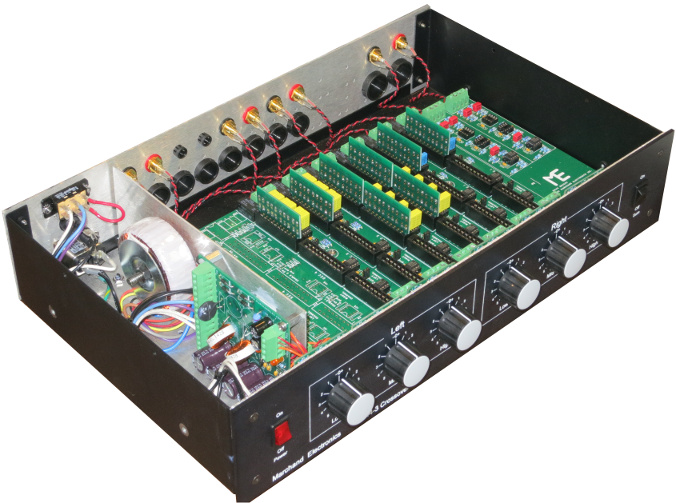
About Electronic Crossover
Networks
The
electronic crossover is used to drive individual
loudspeakers for separate portions of the audio frequency
spectrum. A two way crossover is used for bass and high
frequency speakers. A three way crossover is used when
driving bass, midrange and high frequency speaker. The
signal from the preamp is passed to the electronic crossover
network. The outputs of the crossover network are then
connected to the power amplifiers for the individual
loudspeakers. A typical configuration like this might have
the crossover frequency set at 300 to 1000 Hz, depending on
the type of loudspeakers used. When used with
subwoofers as low frequency speakers, the typical crossover
frequency is around 100 Hz. The range is 50 to 150 Hz for
most subwoofers. When the crossover frequency is below 100
Hz there usually is no stereo information present from the
sound of the subwoofer, and a common subwoofer can be used.
The sum switch on the crossover front panel causes the
outputs of both low pass channel to be summed together. Both
outputs will have the same summed signal on them, and either
one can thus be used to drive he common subwoofer. The
advantage of a common subwoofer is more than just cost.
Because there is only one subwoofer present, often a larger
unit can be chosen, with an extended bass range.
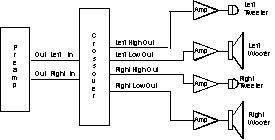
Figure 1
A typical 2-way system
It is also
possible to drive more than two speakers per channel. A
three-way crossover would be used to drive a system with
woofers, midranges and tweeters.
Choosing the crossover
frequency
At
frequencies below the crossover frequency the signal will go
to the low-pass outputs. At frequencies above the crossover
frequency the signal will go to the high-pass outputs. There
is a region around the crossover point where the signal will
come out of both the high pass output and the low pass
output. For the crossover networks with a slope of 24
dB/octave (XM6, XM9 and XM26) the width of this region is
about 1/2 octave. For the XM16, with a slope of 48
dB/octave, the width of this region is halved to 1/4 octave.
Figure 2 shows the frequency response of the 24 dB/octave
crossover networks (XM6, XM9 and XM26). The figure is drawn
for a crossover frequency of 100 Hz. For other crossover
frequencies the same figure applies, with the frequency
scale scaled. Note that both the high-pass response and the
low-pass response are down exactly 6 dB at the crossover
point of 100 Hz. This means that at this frequency the
amplitude is exactly half. Adding the high-pass and low-pass
together sum to unity. As a matter of fact the sum of the
high-pass and the low-pass response is unity for all
frequencies. This is why the filter is called a “constant
voltage” network. It is also called a Linkwitz-Riley
network.
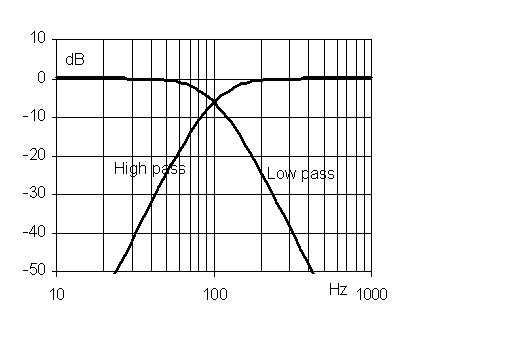
Figure 2
Fourth order frequency response of amplitude
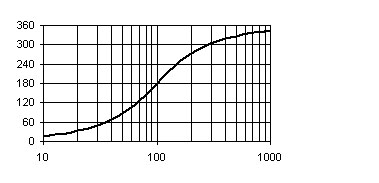
The frequency
response of the phase of the 24 dB/octave network is shown in
figure 3. The frequency response of the phase is the same for
the high-pass and the low-pass outputs. Note that at the
crossover point the phase shift is exactly 180 degrees.
The choice of the crossover point is a difficult one, and
often some trial and error is needed for achieving best
results. With the 24 dB/octave crossover networks a good rule
of thumb is to set the crossover point at least one-half to
one octave away from the cutoff frequency of the speaker. Thus
a satellite with a cutoff frequency of 50 Hz at the low and
that is used with a subwoofer requires a crossover frequency
of 75 to 100 Hz. The subwoofer should then also have a range
extending half to one octave above the crossover frequency. In
this case, if 100 Hz was chosen, the subwoofer should have a
range of at least 200 Hz.
Figure 3
Fourth order frequency response of phase.
Level controls
The level
controls on the front of the cabinet are used to set the
volume of each loudspeaker for a proper match. There are
several ways to adjust these controls. A good way to do this
is to start out by setting all controls in the center (12
o’clock) position. Listen to some music and adjust the
controls for proper volume from each speaker.
If a frequency generator is available, hook the generator up
to the input of the crossover. Sweep the frequency from way
below the crossover point to way above the crossover point.
When the frequency crosses the crossover point the sound
should shift from one speaker to the other, but the volume
should remain the same.
A third way is to use a pink noise generator and a spectrum
analyzer with a good microphone. Adjust the level controls for
a flat response across the crossover point.
Sometimes the methods that use instruments result in settings
that are not quite pleasing. If that is the case try to adjust
the controls until the sound is best. After all, it is the
final sound that is important.
The damping control
The
damping control allows adjusting the frequency response at
the crossover point. The damping control has maximum effect
near the crossover frequency, and almost no effect far from
the crossover frequency. Figure 4 shows the frequency
response for the maximum and minimum settings. This control
is only available on the XM6 and the XM9. The damping
control adjusts both high pass and low pass simultaneously.
This control is useful for fine-tuning the room frequency
response. Sometimes it happens that at the crossover point
there is a small peak or dip in the frequency response. This
is caused by the fact that at this frequency the sound is
produces by both high and low speakers simultaneously. It is
often very hard to hear this dip, but it can easily be seen
if a frequency spectrum analyzer is used.
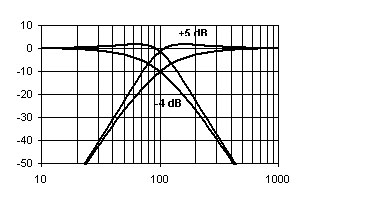
Figure 4
Effect of damping control